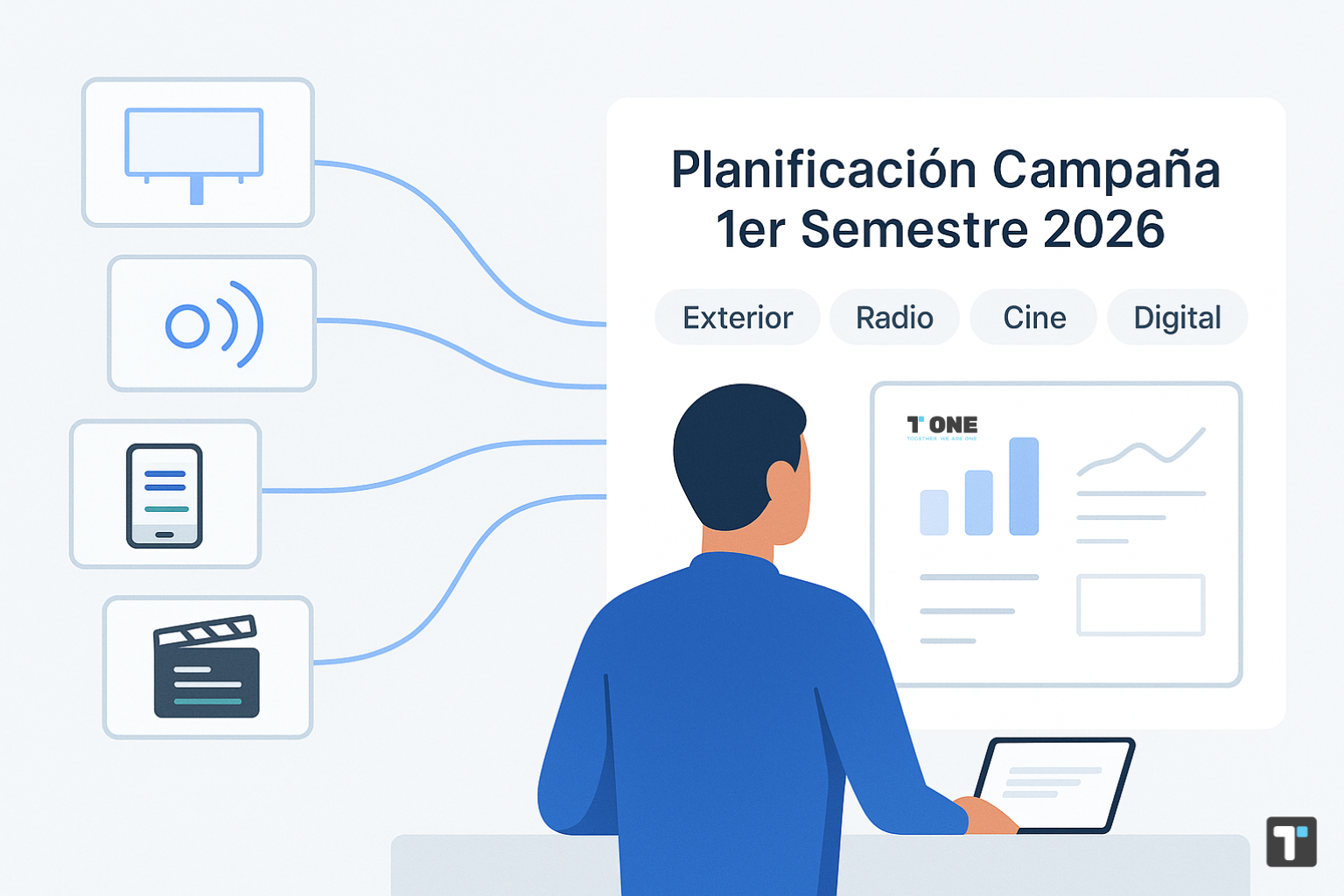
How to plan multichannel campaigns (online + offline) without dying in fragmentation
Multichannel media planning: practical guide for 2026
Learn how to plan online + offline campaigns without fragmentation. Clear strategies, tools and frameworks for efficient multichannel media planning.
Introduction: when fragmentation becomes your biggest operational cost
If you work in marketing or media—whether in Spain or Latin America—the scenario is familiar:
- 20 tabs open,
- endless spreadsheets,
- a DSP for digital,
- manual negotiations for OOH/DOOH,
- emails with PDFs,
- radio contacts,
- cinema deals…
The challenge is not lack of inventory. It’s a lack of connection between everything.
Why multichannel media planning has become so complex?
The advertising industry is living in a time of abundance:
-
more media,
-
more formats,
-
more data,
-
more tools.
But without a system to orchestrate it, that abundance becomes operational noise.
1. Too many channels, zero real integration
Digital, OOH/DOOH, radio, local media, cinema, influencers…
Each one has its own rules, metrics, pricing models and buying processes.
2. Manual processes and operational overload
Teams still rely on Excel, emails, screenshots, PDFs and phone calls.
It’s slow, fragmented and error-prone.
3. No unified view of opportunities
With so much fragmentation, planners lose the ability to evaluate complementary combinations between online and offline.
How to plan multichannel campaigns without wasting time or budget?
The answer is not to cut channels, but to make them work together under a different operating model.
1. Think in complementarity, not isolated channels
Each medium contributes something different:
-
OOH/DOOH → geographic coverage and physical presence.
-
Digital → segmentation and conversion.
-
Cinema → total attention and emotional context.
-
Radio → frequency and day-to-day companionship.
-
Local media → hyper-relevant community context.
A strong multichannel plan is not about “adding more media”.
It’s about designing combinations where each one does what it’s best at.
2. Reduce intermediaries and centralize inventory
The more intermediaries you have, the more friction and the less visibility you get:
-
in pricing,
-
in availability,
-
in real conditions.
The trend is not “yet another tool”, but platforms that integrate physical and digital inventory from many sellers, with clear rules and comparable data.
3. Use a planning “operating system”, not just isolated tools
The efficient model is not:
-
a DSP on its own,
-
or a BI tool that only looks at historical data,
-
or a turbo-charged spreadsheet.
You need a layer that can:
-
unify online + offline inventory,
-
enable contextual matching between campaigns and available media,
-
propose optimised combinations based on objectives,
-
and let you build multichannel plans in minutes, not weeks.
Realistic example: a planner building a campaign in 2026
Objective: drive foot traffic to a restaurant in Bilbao.
In the classic model:
-
Google Ads campaigns,
-
social ads on Meta,
-
maybe some manually booked OOH if there’s time.
In an optimised multichannel model:
-
DOOH in high-traffic areas near the restaurant.
-
Local radio in key dayparts for drive-to-store.
-
Digital gastronomic media and local blogs.
-
Geolocated display with tactical creatives.
-
Cinema in nearby theatres during relevant seasonal peaks.
The outcome is clear:
-
more context,
-
more real-world presence,
-
less dependence on the digital duopoly alone.
T-One’s role in multichannel planning
T-One is a global intelligent commercial management platform for the advertising market that operates as a system of record and system of action for multichannel planning.
In a single environment, it allows advertisers, agencies and media owners to:
-
Unify inventory from thousands of media outlets:
-
OOH, DOOH, cinema, radio, digital, local media and emerging formats.
-
-
Combine online + offline within one interface, using comparable criteria.
-
Generate three automatic planning scenarios aligned with each objective:
-
efficiency,
-
balance,
-
awareness.
-
-
Edit the plan on demand, like a smart cart, without breaking the underlying logic of reach and context.
-
Cut unnecessary commercial/operational steps while keeping the direct relationship between the parties.
Instead of 20 tabs open, you work from one shared space where you can see options, contexts and combinations.
What to do next?
-
Define channels based on context and intent, not just habit.
-
Bring in local media (OOH/DOOH, radio, cinema) to reinforce physical presence.
-
Centralise planning to reduce duplication and manual errors.
-
Prioritise platforms that unify online and offline inventory in a single workflow.
-
Test automatic planning scenarios to save time and reduce personal bias.
Fragmentation is not destiny; it’s a side effect of working with disconnected pieces.
T-One aims to be the place where multichannel planning becomes strategic, transparent and manageable again.
Discover how T-One helps you plan multichannel campaigns without fragmentation, with unified inventory and optimised combinations for your objectives.